
SIP-1111™



WHY ASPHALT GETS HARD TO USE
RAP, VTBs, and stiff blend stocks hold value, but aged binder can make them hard to formulate.
High-RAP mixtures and low-quality asphalt streams can reduce cost and preserve valuable material, but aged or highly processed binder often brings cracking risk, compatibility problems, and tighter formulation windows.
SIP-1111™ uses reactive semi-epoxidized soybean-oil chemistry to improve aged-binder mobility, compatibility, and balanced asphalt performance.
The same chemistry supports multiple asphalt workflows, from high-RAP mix design and terminal PG formulation to polymer-extension, cold recycling, and refinery blend-stock strategy.
Preserve more value from aged asphalt, stiff streams, and recycled pavement with a formulation path built around reactive chemistry.
REACTIVE SOY CHEMISTRY
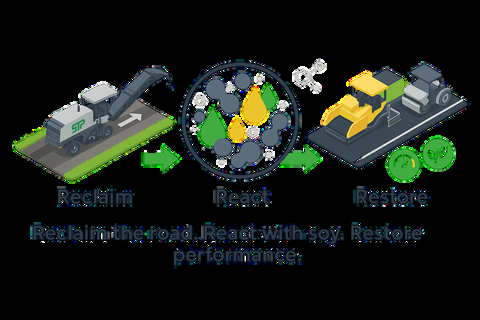
Reactive soybean-oil chemistry for binder restoration and formulation.
SIP-1111™ is built on semi-epoxidized soybean-oil chemistry.
SIP-1111™ pairs reactive semi-epoxidized soybean-oil chemistry with binder, mixture, and field performance data for asphalt buyers working with aged or difficult materials.
| Decision point | Conventional softening | SIP-1111™ reactive formulation |
|---|---|---|
| Main role | Dilutes or softens binder to reach a handling or grading target. | Uses reactive soybean-oil chemistry as part of a binder-restoration or formulation strategy. |
| Performance evaluation | Commonly measured through viscosity, binder grade, and handling properties. | Evaluated through binder rheology, balanced mixture testing, independent laboratory reports, and field demonstrations. |
| Buyer question | How much softening do I get? | What binder, RAP, residue, or project problem can we solve while preserving balanced performance? |
Reactive enough to be different. Practical enough to formulate.
RESULTS ACROSS CLIMATES, MIXES, AND TEST METHODS
High-recycled-content asphalt, measured in the lab and proven on the road.
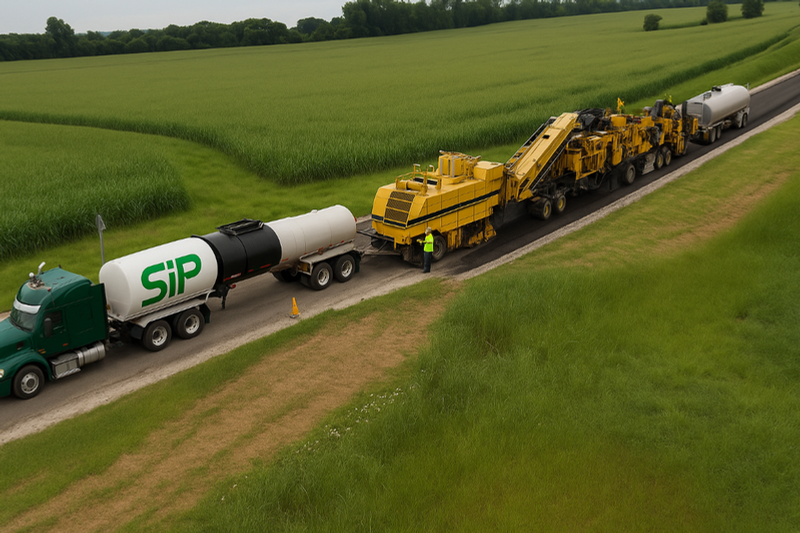
SIP-1111™ has distinguished itself in head-to-head recycling-agent research, balanced mix testing, peer-reviewed field work, and accelerated trafficking.
Emily, Minnesota
40% RAP · PG 52-34In MnDOT's seven-agent NRRA study, the SIP-1111™ section reached an as-extracted PG 52-34. After three years, it had the highest phase angle and lowest |E*| among the recycling-agent sections, while maintaining the lowest Glover-Rowe values after laboratory aging.
NCAT Test Track S1
50% RAP · 4M ESALsIn one 50% RAP mixture, IDEAL-CT increased from 32.2 without rejuvenator to 54.2 at 3.5% SIP-1111™ and 57.7 at 4.1%. The monitored section carried about 4 million ESALs in its first year with no visible cracking and rut depth below 3.5 mm.
Mason City, Iowa
Higher CT and DCTAt the same 45% RAP level, the SIP-1111™ design recorded a CT Index of 119.4 and DCT fracture energy of 490.67 J/m², compared with 101.54 and 363 J/m² for the TuffTrek design.

Indiana field demonstration
40% RAP · Peer reviewedThe peer-reviewed Fuel study reports that a 40% RAP SIP-1111™ field system achieved PG 64-28 and DCT fracture energy of 506.7 J/m², compared with PG 64-22 and 375.7 J/m² for the 25% RAP control.
Results are specific to the materials, dosages, conditioning, traffic, climate, and test methods reported for each project.
FIELD PROOF NETWORK
Proven across production plants, public roads, and full-scale test sections.
Explore 18 SIP-1111™ field records, including BioMAG™ blends made with 50% SIP-1111™ rejuvenator and 50% biopolymer. Select a state to open each project story.

BUYER PATHS
Choose your SIP-1111™ path
Start with your material stream and production process, then review the corresponding technical results and product documents.
HMA producer or contractor
Review SIP-1111™ for high-RAP mix design, BMD testing, cracking resistance, rutting checks, and field-demonstration context.
Review HMA pathOwner agency or specifier
Review agency reports, technical documents, and project testing needed to evaluate SIP-1111™ for a recycling-agent specification.
Discuss a specificationAsphalt terminal
Explore SIP-1111™ as a reactive flux for PG-grade formulation and difficult blend stocks.
Talk formulationPolymer or PolyExtend buyer
Review measured PolyExtend grade, MSCR, and elastic-recovery results for polymer-modifier and blend-stock optimization.
Review PolyExtendCIR, CCPR, or foamed-asphalt team
Review foamed-asphalt cold recycling and direct RAP-millings treatment for central-plant production.
Review CIR pathRefinery or residue blender
Evaluate SIP-1111™ for vacuum tower bottoms, solvent deasphalting pitches, stiff residues, and blend-stock strategy.
Review refinery pathScience Backed Rejuvenation and Warm Mix Technology
The science story: reactive restoration of aged asphalt systems.
SIP-1111™ applies semi-epoxidized soybean-oil chemistry to aged asphaltene behavior, RAP and low-quality asphalt compatibility, and formulation support for real asphalt buyers.
- What the chemistry targets Peer-reviewed asphalt source text links epoxidized vegetable-oil derivatives to chemical passivation of agglomerated asphaltenes in low-quality asphalt and RAP.
- Why buyers care Better binder compatibility and balanced mixture performance can open higher-RAP, stiff-blend-stock, and refinery-residue strategies that inert softening alone may not solve.
- Explore the evidence The issued patent documents the chemistry and applications. Peer-reviewed papers and field reports present performance across tested binders, mixtures, and projects.
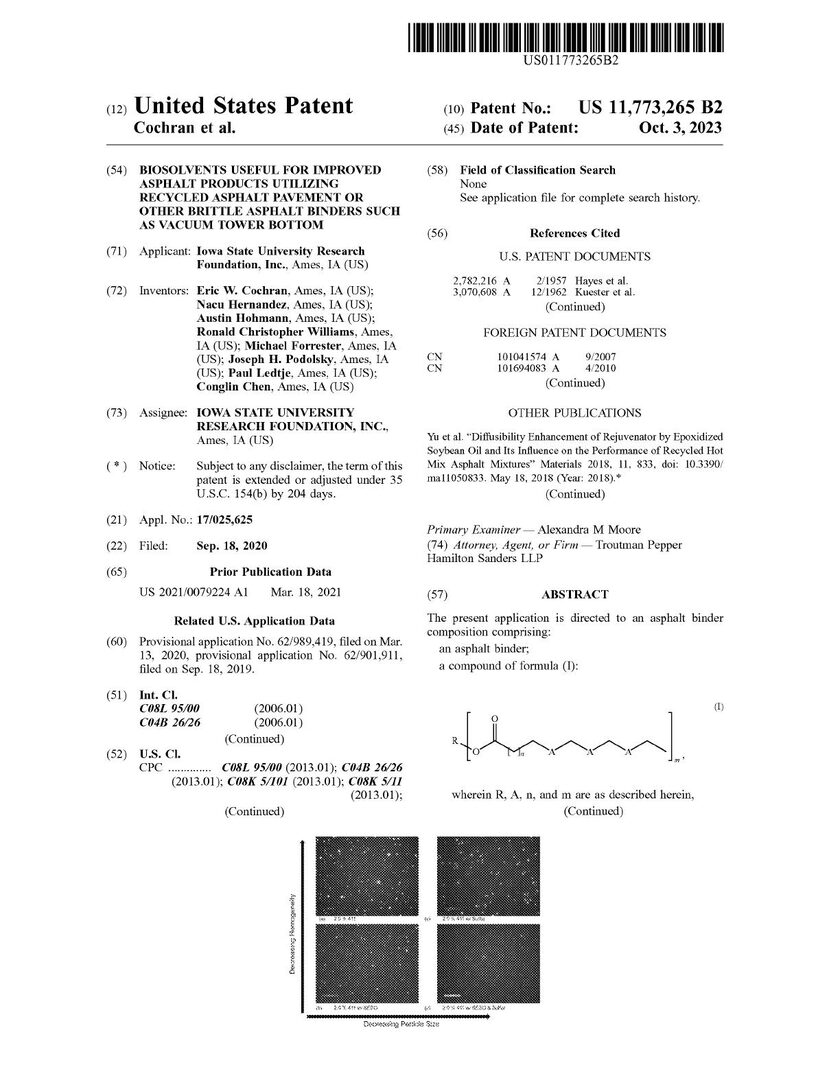
Issued patent
RAP and brittle-binder patent
Covers biosolvent compositions for improved asphalt products using RAP or brittle asphalt binders such as vacuum tower bottoms.
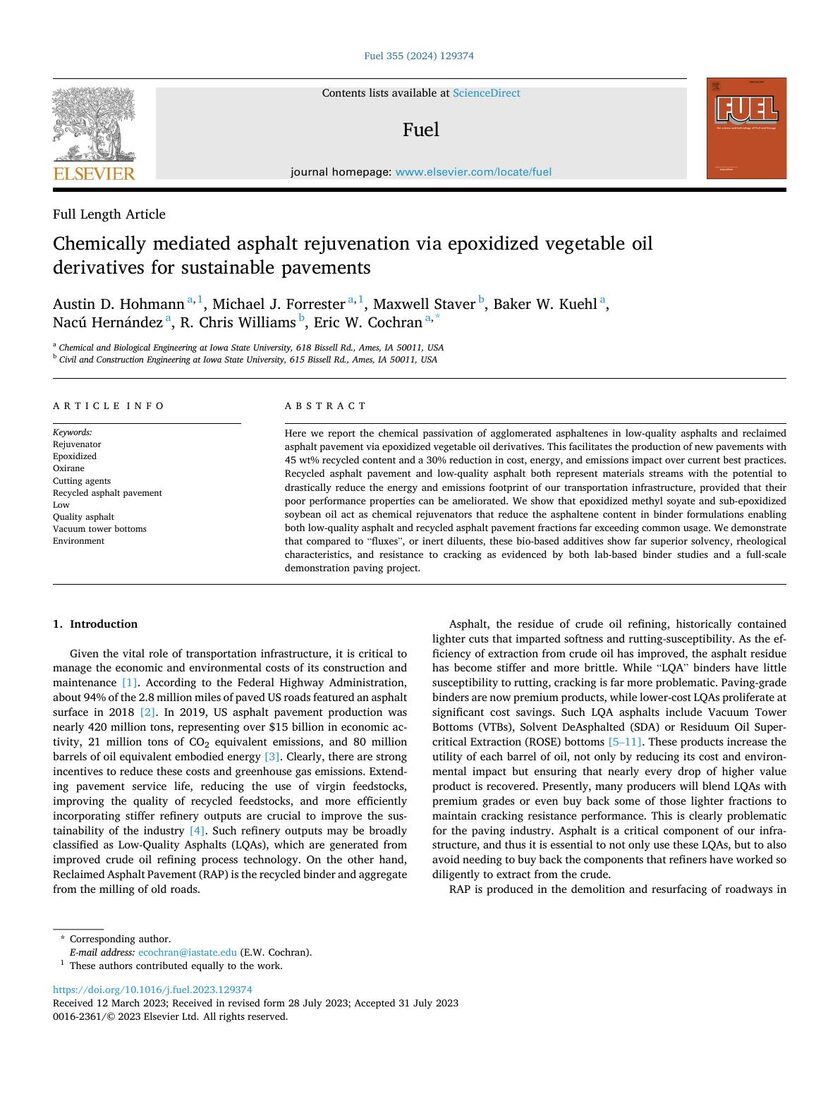
Journal article
Hohmann et al. Fuel paper
Peer-reviewed asphalt paper connecting epoxidized vegetable-oil chemistry, RAP and low-quality asphalt, lifecycle analysis, and a full-scale Indiana field demonstration.
Hohmann, Austin D.; Forrester, Michael J.; Staver, Maxwell; Kuehl, Baker W.; Hernandez, Nacu; Williams, R. Chris; Cochran, Eric W. "Chemically mediated asphalt rejuvenation via epoxidized vegetable oil derivatives for sustainable pavements." Fuel 355 (2024) 129374. https://doi.org/10.1016/j.fuel.2023.129374.
EVIDENCE BUYERS CAN INSPECT
Open the reports, research, and product documents.
Review the technical record behind SIP-1111™, from handling data and peer-reviewed chemistry to mixture testing and field performance.
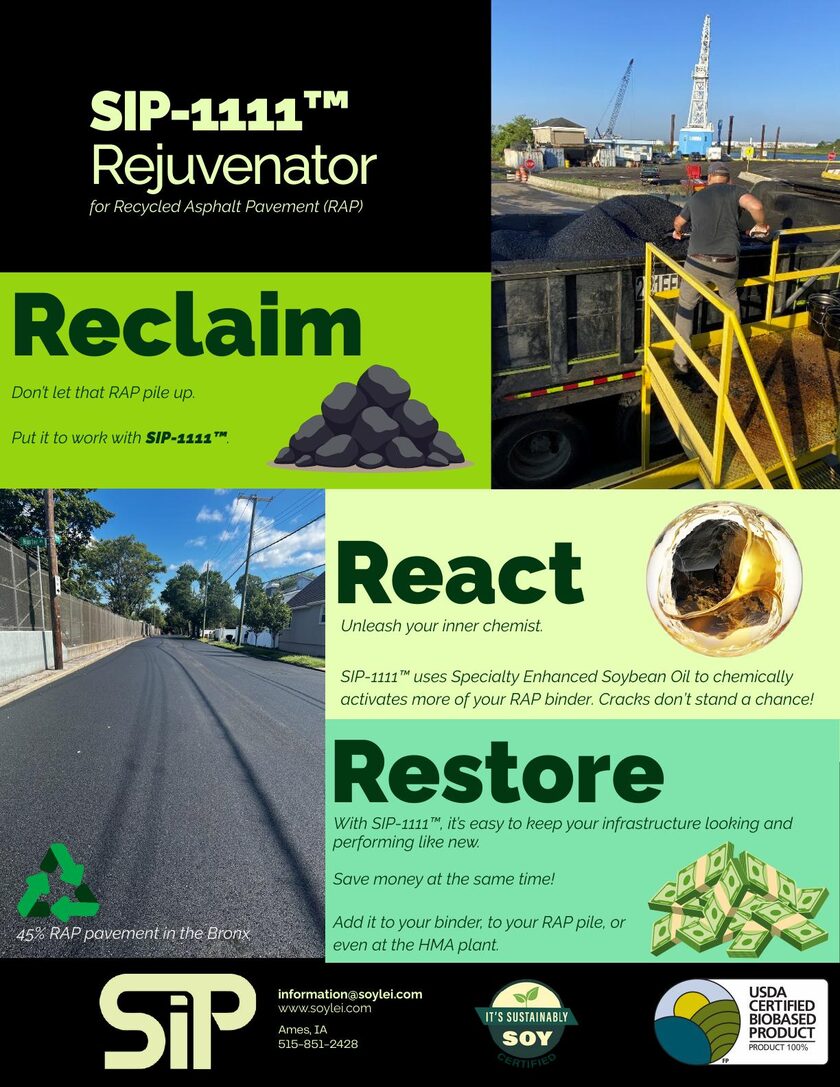
SIP-1111™ brochure and case study
Commercial overview and current product collateral for the HMA rejuvenator path.
Open brochure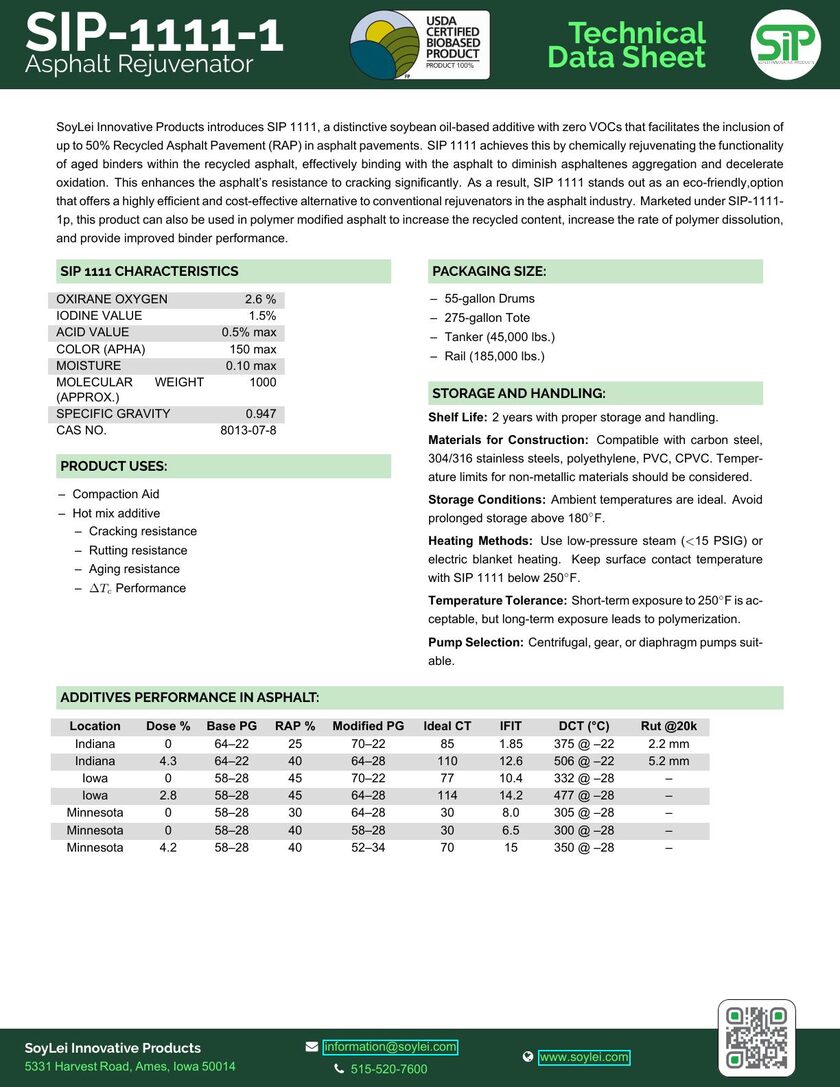
Technical data sheet
Technical product details for buyers evaluating SIP-1111™ handling, use, and documentation requirements.
Open TDS
Hohmann et al. Fuel paper
Peer-reviewed asphalt article on epoxidized vegetable-oil rejuvenation, RAP and low-quality asphalt, lifecycle impact, and the Indiana field demonstration.
Read manuscript
Licensed triglyceride and asphalt patents
Family-grouped listing of issued patents and published applications across SoyLei's licensed Iowa State technology platform.
Review portfolio
AASHTO PEAS evaluation
Customer-focused interpretation of AASHTO DataMine AMRA-2025-02-003 with a hosted copy of the complete report.
Review evaluation45% RAP balanced mix study
Verified IDEAL-CT and Hamburg results from an engineered high-RAP mixture evaluated by Blankenship Asphalt Tech & Training.
Read studyBlinded ATS recycling-agent study
A contractor-centered 35% RAP comparison covering Hamburg rutting resistance, CT Index, and normalized dosage.
Read studyTECHNICAL BUYER QUESTIONS
SIP-1111™ FAQ
What makes SIP-1111™ different from conventional recycling agents?
SIP-1111™ is a semi-epoxidized soybean-oil chemistry designed to interact with aged asphalt binder. It restores mobility and low-temperature behavior while the producer tunes dosage and mixture structure for the required rutting resistance.
What did the AASHTO PEAS evaluation test?
AASHTO DataMine AMRA-2025-02-003 compared a 45% RAP control mixture with the same mixture containing SIP-1111™ at 3.2% by weight of virgin binder. The program reported binder grading, Delta Tc, MSCR, Hamburg, Overlay, and IDEAL-CT results.
What were the main AASHTO PEAS results?
The treated binder reached a one-PAV continuous grade of 63.5/-28.7 versus 69.7/-23.6 for the control. Overlay cycles increased from 225 to 300.3, short-term IDEAL-CT Index increased from 14.6 to 16.7, and Hamburg rut depth was 3.5 mm versus 3.1 mm at 20,000 passes.
How much RAP has SIP-1111™ been used with?
The current evidence base includes high-RAP laboratory and field mixtures ranging from 36% RAP plus 5% RAS to 50% RAP. Project design still depends on recovered-binder properties, virgin-binder grade, aggregate structure, climate, and traffic.
How should a producer select dosage?
Start with recovered and virgin binder properties, then verify the proposed dosage through PG grading and balanced mixture tests such as IDEAL-CT, DCT, Overlay, or Hamburg as required by the agency and project. SoyLei supports this formulation work.
Can SIP-1111™ support polymer-modified asphalt?
Yes. PolyExtend laboratory work shows that addition sequence can tune the grade window. Formulations with 5% polymer and 1.5% SIP-1111™ reached PG 82-22 or PG 76-28 pathways while retaining E-class MSCR performance at 64°C.
How does SIP-1111™ support cold recycling?
SIP-1111™ can be formulated for foamed-asphalt cold-recycling systems. For central-plant processing, SoyLei recommends applying SIP-1111™ directly to RAP millings before mixing, curing, and compaction.
Can terminals and refineries use SIP-1111™ as a blend stock?
Yes. Terminals can use SIP-1111™ as a reactive flux when formulating PG grades from stiff blend stocks. Refineries can evaluate it with vacuum tower bottoms, solvent deasphalting pitches, and other highly processed residues.
Is SIP-1111™ available commercially?
Yes. Contact SoyLei with the application, target volume, delivery location, binder or residue data, and required performance grade. The technical team will align pricing, documents, and formulation support with the project.
PRICING AND TECHNICAL SUPPORT
Commercial supply and formulation support
SIP-1111™ buyers move through technical conversation, pricing, and formulation support.
Request pricing
Start a commercial conversation about volume, application, delivery, and documentation needs.
Talk formulation
Bring RAP targets, binder grades, residues, or terminal constraints to SoyLei's technical team.
Review documents
Open the TDS, SDS, brochures, AASHTO report, research articles, and licensed patent portfolio.
Plan a project
Scope mix-design, terminal, CIR, refinery, or field-demonstration work around your materials and performance targets.
READY TO FORMULATE?
Bring SoyLei your RAP target, binder grade, refinery residue, or cold-recycling problem.
SIP-1111™ is sold through commercial and technical support channels. Contact SoyLei for pricing, formulation guidance, documents, and project-fit review.