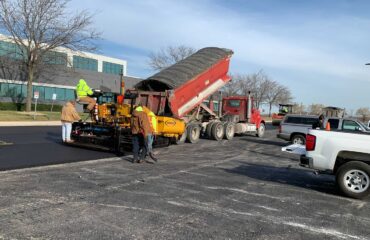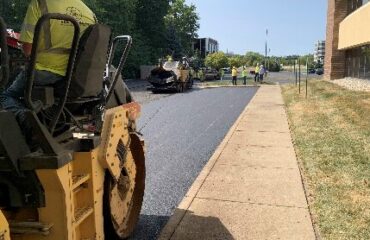
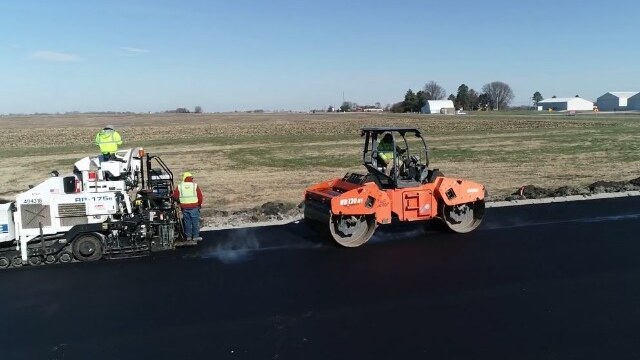
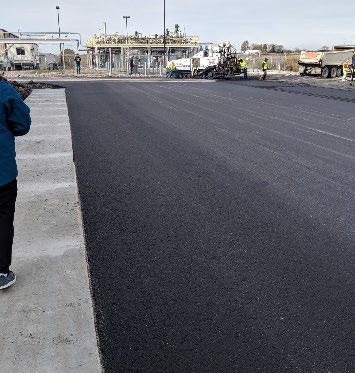
On November 8, 2019, Iowa State University and its partners paved the north parking lot at the BioCentury Research Farm near Boone, Iowa. The United Soybean Board showcase paired 18% reclaimed asphalt pavement with a formulation containing 6% BioMAG™ and 2% SBS.
BioMAG™ combines 50% SIP-1111™ rejuvenator with 50% biopolymer. The Boone project put that formulation into full-scale hot-mix production while measuring continuous binder grade, ΔTc, and Multiple Stress Creep Recovery before modification and after RAP recovery.
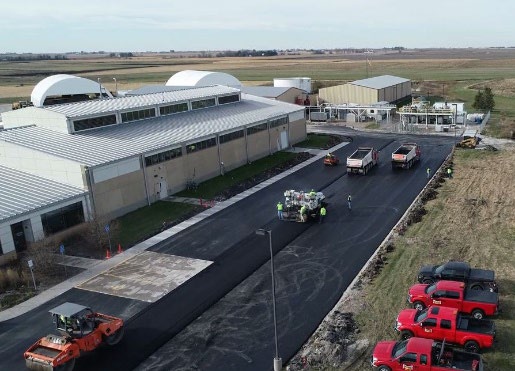
A terminal-ready blending sequence
The Boone team concentrated BioMAG™ with SBS to promote interaction between the materials, then diluted the concentrate to the target formulation. Bituminous Materials blended the liquid binder before delivery to the paving contractor. The project tracking record documents vessel blending at the terminal over three and a half days before shipment.
This production sequence connected soybean-based rejuvenation and polymer chemistry with existing terminal and contractor equipment. The final formulation used 2% SBS; the project case study identified 4–5% SBS as the typical range for the reported elastic recovery.
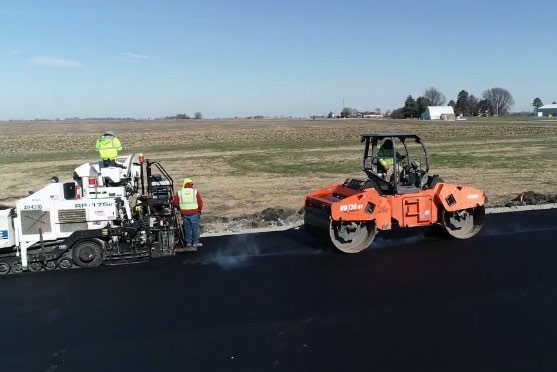
Broader grade range with 2% SBS
The unmodified 64-24 source binder measured continuous critical temperatures of 66.2°C and -24.3°C. After modification with 6% BioMAG™, 2% SBS, and 0.13% sulfur, the binder measured 69.9°C and -30.5°C. That expanded the continuous temperature range from 90.5°C to 100.4°C while improving both the high- and low-temperature endpoints.
At 58°C, MSCR recovery increased from 1.21% to 59.63%, while Jnr decreased from 1.45 to 0.4006 kPa-1. The modified binder also recorded 40.61% recovery and 1.1802 kPa-1 Jnr at 64°C.
Performance after 18% RAP recovery
Binder recovered from the 18% RAP mix measured continuous critical temperatures of 71.8°C and -29.9°C, a ΔTc of +1.0°C, and 48.58% MSCR recovery at 58°C. Its Jnr measured 0.3861 kPa-1 at 58°C and 1.1027 kPa-1 at 64°C.
| Binder condition | Continuous PG endpoints | ΔTc | MSCR at 58°C | MSCR at 64°C |
|---|---|---|---|---|
| 64-24 source binder | 66.2 / -24.3°C | -1.1°C | 1.21% recovery; 1.45 kPa-1 Jnr | Not reported |
| 6% BioMAG™ + 2% SBS | 69.9 / -30.5°C | +0.3°C | 59.63% recovery; 0.4006 kPa-1 Jnr | 40.61% recovery; 1.1802 kPa-1 Jnr |
| Recovered with 18% RAP | 71.8 / -29.9°C | +1.0°C | 48.58% recovery; 0.3861 kPa-1 Jnr | 31.05% recovery; 1.1027 kPa-1 Jnr |
What Boone demonstrates for asphalt teams
Boone brought terminal blending, polymer extension, reclaimed asphalt, and full-scale placement into one production sequence. With only 2% SBS, the BioMAG™ formulation delivered a 100.4°C continuous grade span before RAP recovery. After 18% RAP entered the mix, the recovered binder retained a -29.9°C low-temperature endpoint, positive ΔTc, and 48.58% MSCR recovery at 58°C.
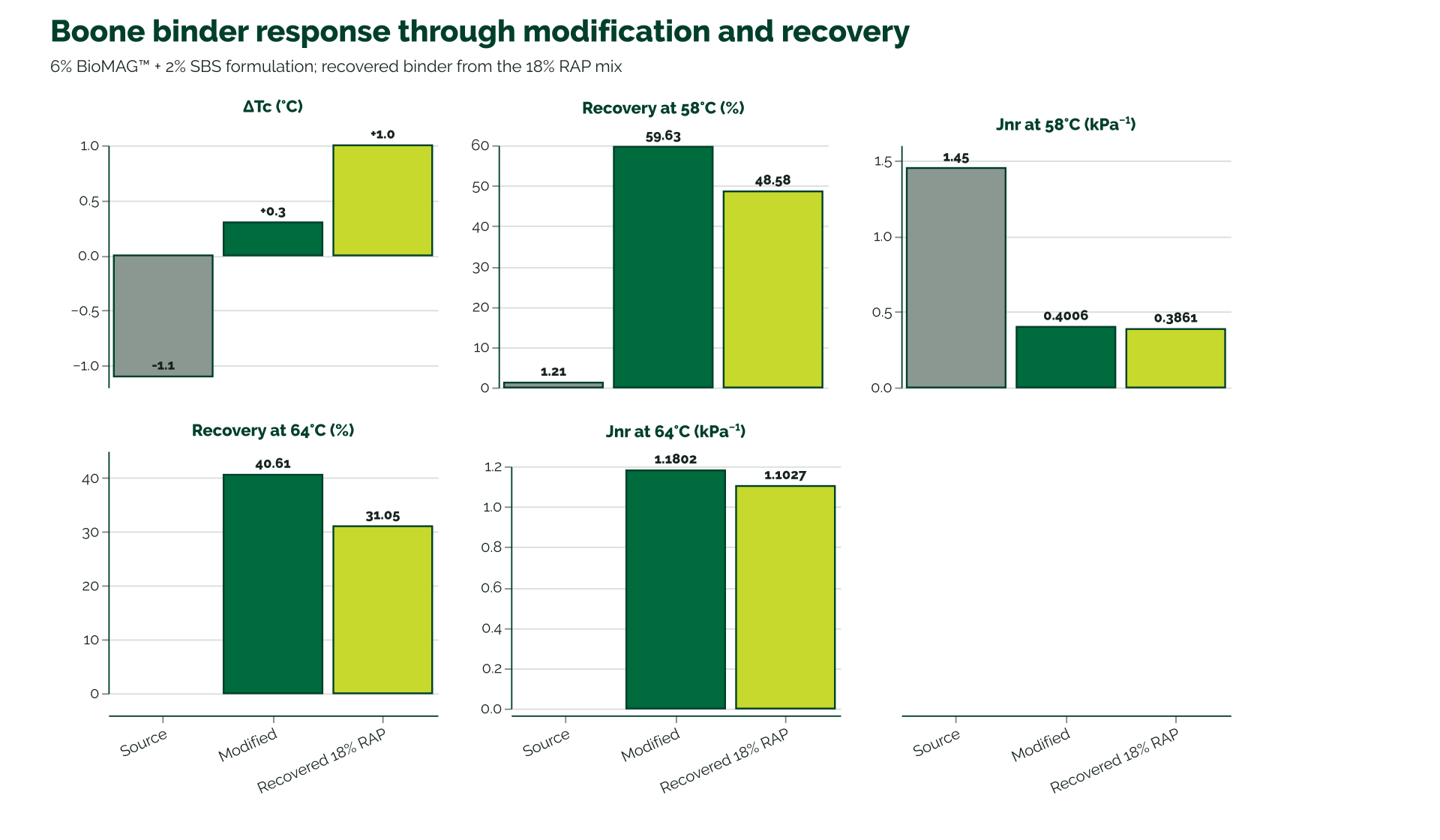
Higher MSCR recovery, lower Jnr, and less-negative ΔTc are favorable. Missing source-binder 64°C values remain absent.
| Stage | ΔTc (°C) | Recovery 58°C (%) | Jnr 58°C (kPa⁻¹) | Recovery 64°C (%) | Jnr 64°C (kPa⁻¹) |
|---|---|---|---|---|---|
| Source binder | -1.1 | 1.21 | 1.45 | Not reported | Not reported |
| 6% BioMAG™ + 2% SBS | 0.3 | 59.63 | 0.4006 | 40.61 | 1.1802 |
| Recovered 18% RAP binder | 1 | 48.58 | 0.3861 | 31.05 | 1.1027 |
Source: Case Studies in BioMAG. BioCentury Research Farm section, Table 4, PDF page 5
BioCentury Research Farm project video
BioMAG™ at the BioCentury Research Farm
Project release video from the BioCentury Research Farm north parking-lot demonstration in Boone, Iowa.
Review SIP-1111™ · See related demonstration projects · Discuss a high-RAP or polymer-modified formulation with SoyLei
Source Documents
- Development of Bio-Based Polymers for Use in Asphalt, Phase II, Iowa State University Institute for Transportation, 2020
- SIP-1111™ Demonstration Paving Results, SoyLei Innovations, 2025