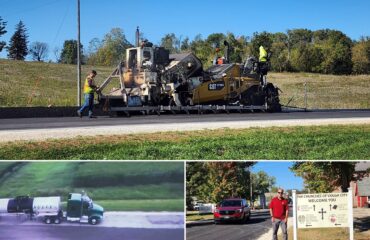
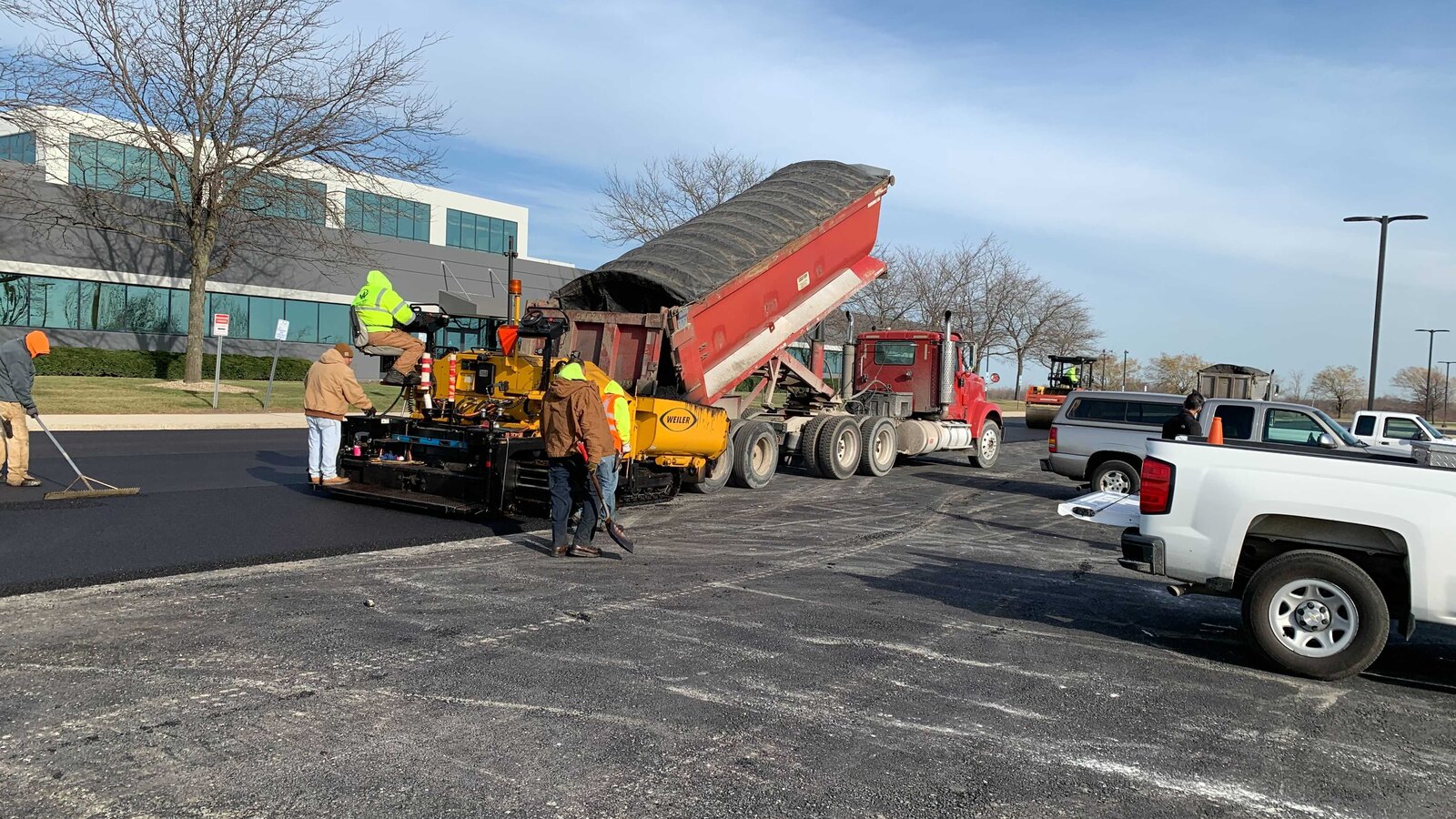
On November 19, 2020, Gallagher Asphalt produced a full-scale Illinois demonstration for placement at 200 Applied Parkway in University Park. The production run delivered approximately 600 tons of SIP-1111™-treated mix within a 740-ton control-and-demonstration sequence.
Turning a 58-28 binder into a high-recycled-content design
The demonstration paired a 58-28 base binder with 5% SIP-1111™, approximately 35–36% RAP, and 5% RAS. The comparison used the producer’s 46-34 control design with the same recycled-material loading.
Iowa State University’s extracted-binder results graded the SIP-1111™ design at PG 70-16, compared with PG 70-10 for the control. The treated design expanded the overall recovered-binder PG range from 90.2°C to 93.2°C while maintaining the same PG 70 high-temperature grade. Its ΔTc improved from -15.3°C to -11.4°C.
Cracking and rutting performance
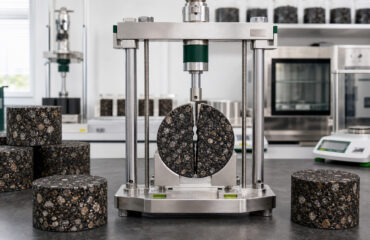
ISU measured an IFIT index of 18.8 for the SIP-1111™ design versus 13.6 for the control. CT Index measured 189.5 versus 193, while DCT fracture energy measured 515 versus 559 J/m².
Chicago Testing Laboratory measured 9.0 mm of Hamburg rut depth at 20,000 passes for the SIP-1111™ mix, compared with 11.81 mm for the control. CTL’s IFIT results favored the control at both the initial and long-term conditions, showing the cracking response changed with laboratory and conditioning protocol.
ISU’s preliminary quality-control record identified specimens outside its specified air-void limits for replacement before the testing summary was finalized. The ISU and CTL values above remain separated by laboratory and conditioning protocol.
What University Park demonstrates
The University Park project moved a lower-temperature 58-28 base binder into a PG 70-16 recovered-binder range while carrying approximately 35–36% RAP and 5% RAS. It combined a stronger ISU IFIT result with lower CTL Hamburg rut depth and full-scale production at approximately 600 treated tons.
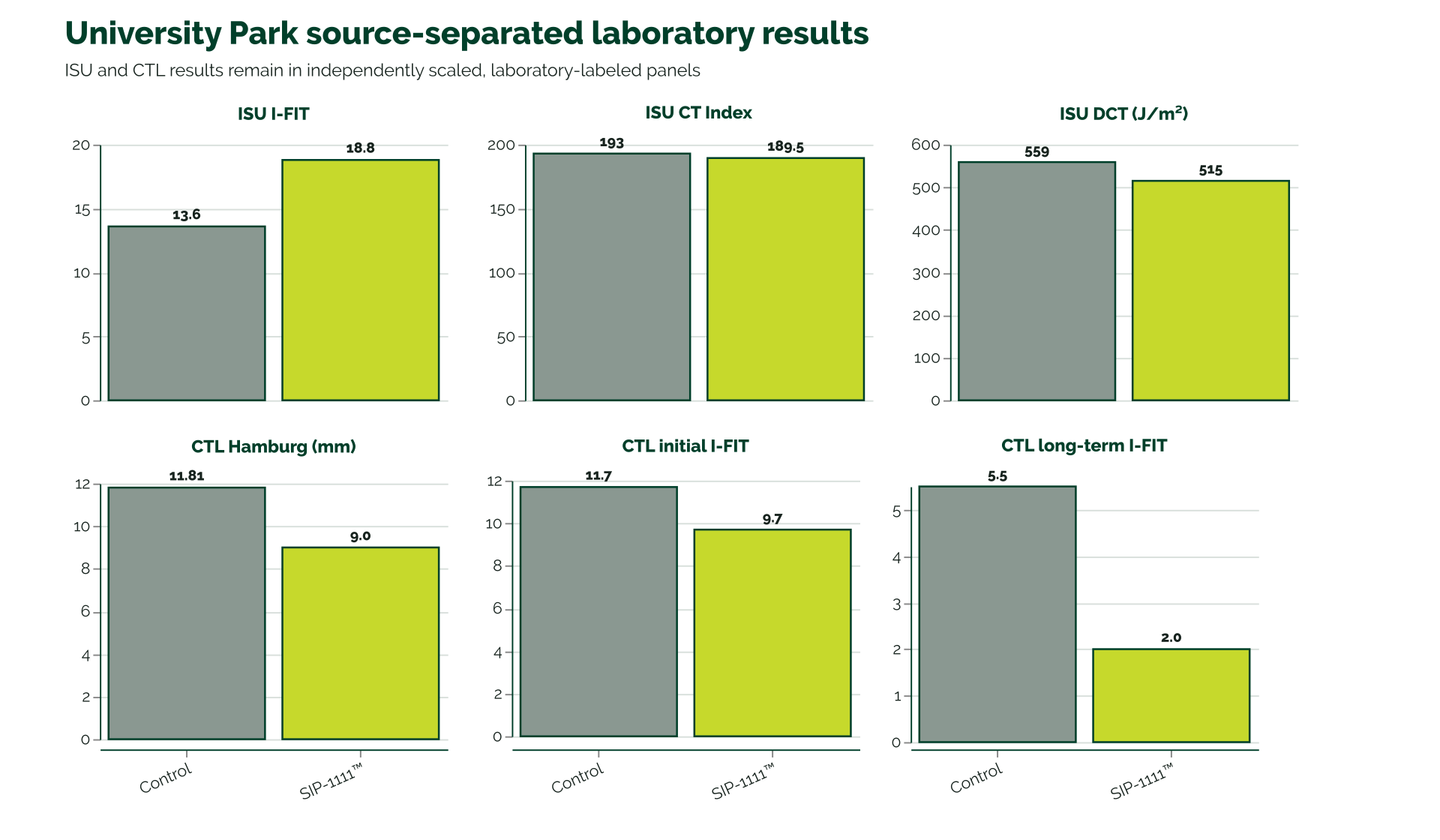
Higher cracking indices and lower Hamburg rut depth are favorable; ISU and CTL conditions are not merged.
| Laboratory | Metric | Treated | Control | Unit |
|---|---|---|---|---|
| ISU | I-FIT | 18.8 | 13.6 | index |
| ISU | CT Index | 189.5 | 193 | index |
| ISU | DCT | 515 | 559 | J/m² |
| CTL | Hamburg | 9 | 11.81 | mm |
| CTL | Initial I-FIT | 9.7 | 11.7 | index |
| CTL | Long-term I-FIT | 2 | 5.5 | index |
Source: SIP-1111 Demo Paving Results. Slide 20 ISU table and slide 22 CTL table
Review SIP-1111™ · See related demonstration projects · Discuss a high-recycled-content mix with SoyLei
Source Documents
- SIP-1111™ Demonstration Paving Results, SoyLei Innovations, 2025