

This 500-ton parking-lot trial was placed at the Indiana Soybean Alliance headquarters in Indianapolis, with the mixture produced at a Noblesville-area plant. The peer-reviewed Fuel paper compares a 40% RAP SIP-1111™ section against a 25% RAP control and reports the complete cracking-and-rutting performance tradeoff.
The same parking lot contained a separate BioMAG™ section. This article covers the SIP-1111™-only section reported in Fuel; the BioMAG™ section article covers its combined rejuvenator-and-biopolymer formulation and project-summary results.
Field comparison
The design used a PG 64-22 base binder. The treated section contained 40% RAP and SIP-1111™ at 5.7% by weight of neat binder; the control contained 25% RAP.
| Measure | 25% RAP control | 40% RAP treated section | Interpretation |
|---|---|---|---|
| Recovered binder PG | PG 64-22 | PG 64-28 | Colder low-temperature grade in this field comparison |
| ΔTc | -3.6°C | 0.2°C | More favorable cracking-related binder result |
| DCT fracture energy | 376.0 J/m² | 506.7 J/m² | Higher fracture energy in the treated section |
| Hamburg rut depth | 2.6 mm | 6.7 mm | Higher rut depth in the treated section |
EMS and SIP-1111™ follow different chemistry paths
The paper separately evaluates epoxidized methyl soyate (EMS) and the partially epoxidized soybean-oil chemistry commercialized as SIP-1111™. In the VTB dose-response study, SIP-1111™ retained low RTFO mass loss, while EMS reached 1% RTFO mass loss at 10% dosage that the authors attributed to methanol evolution. The Indianapolis field section used the SIP-1111™ chemistry.
What the Indiana result establishes
The demonstration connects a commercially produced 40% RAP mixture to recovered-binder grade, ΔTc, DCT, and Hamburg measurements. Against the 25% RAP control, the SIP-1111™ section produced the colder recovered-binder low-temperature grade, a more favorable ΔTc, and higher DCT fracture energy, together with higher measured Hamburg rut depth.
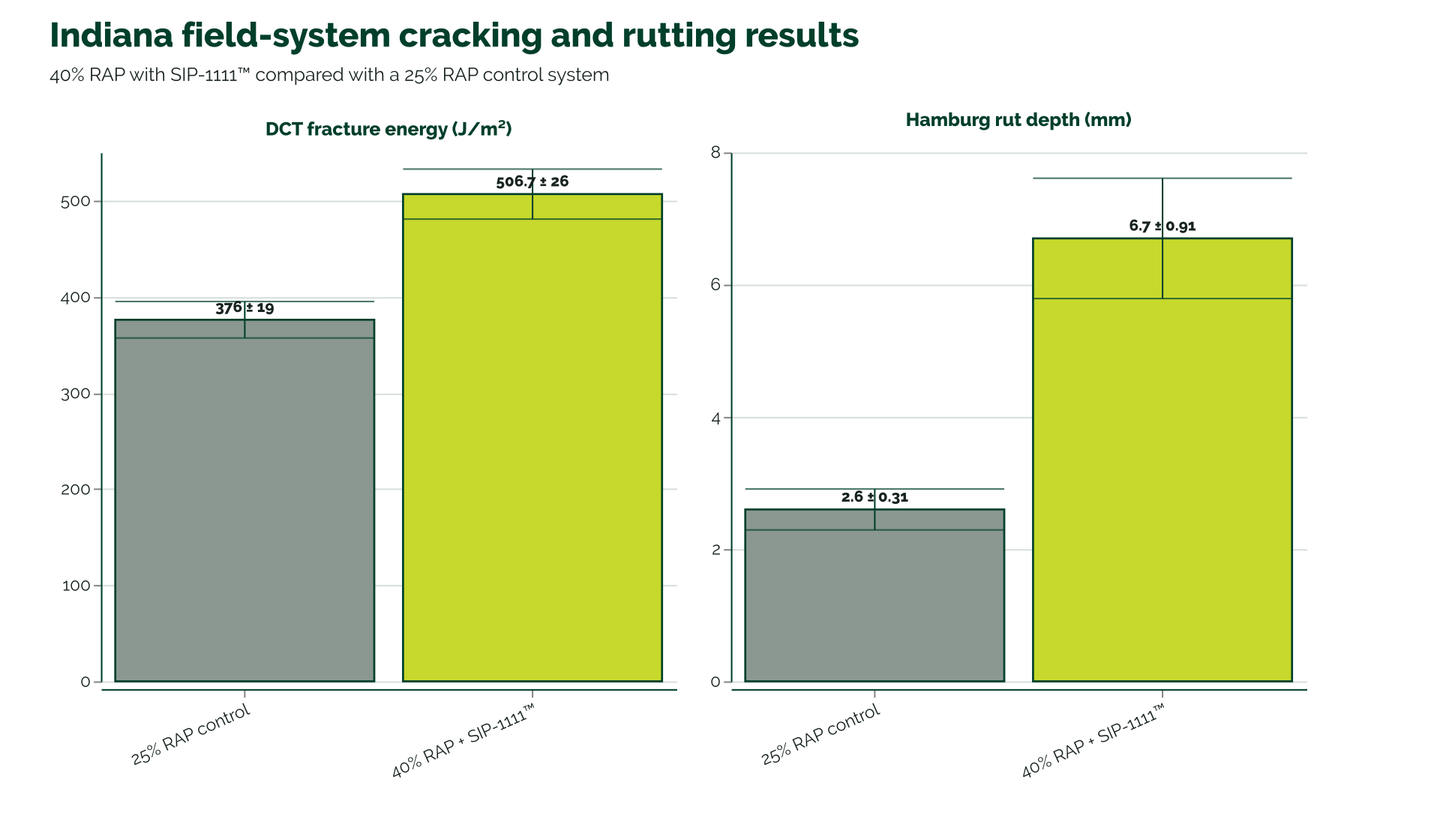
Higher DCT fracture energy and lower Hamburg rut depth are favorable; the systems differ in RAP content.
| Field system | RAP (%) | Metric | Mean | Standard deviation | Unit |
|---|---|---|---|---|---|
| 25% RAP control | 25 | DCT fracture energy | 376 | 19 | J/m² |
| 40% RAP + SIP-1111™ | 40 | DCT fracture energy | 506.7 | 26 | J/m² |
| 25% RAP control | 25 | Hamburg rut depth | 2.6 | 0.31 | mm |
| 40% RAP + SIP-1111™ | 40 | Hamburg rut depth | 6.7 | 0.91 | mm |
Source: Hohmann et al., Fuel 355 (2023). Section 3.5 and Table 1, published PDF page 8
Review SIP-1111™ · See related demonstration projects · Discuss a high-RAP mixture with SoyLei
Source Documents
- Chemically mediated asphalt rejuvenation via epoxidized vegetable oil derivatives for sustainable pavements, Fuel, 2023
- SIP-1111™ Demonstration Paving Results, SoyLei Innovations, 2025