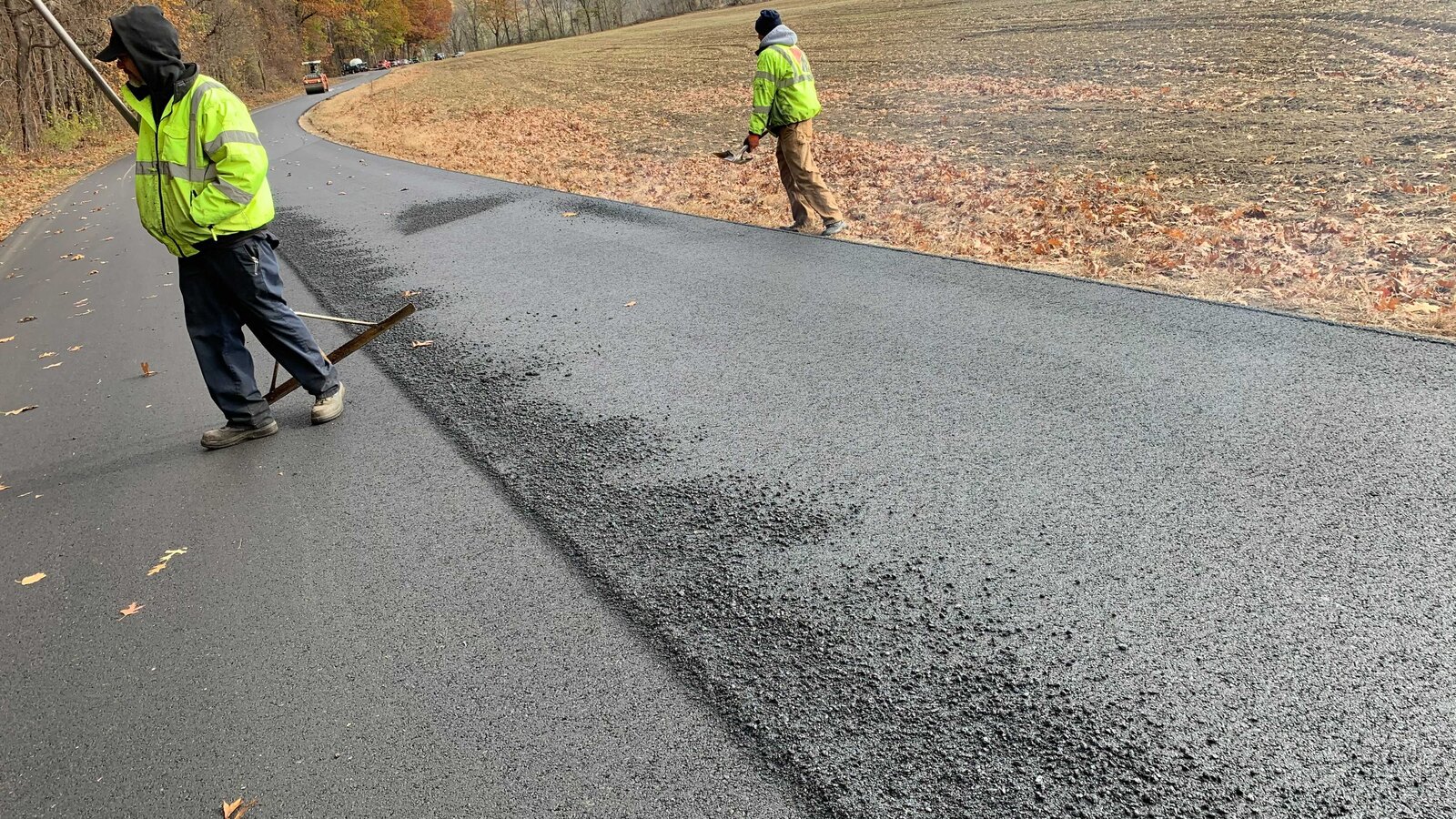
In November 2020, All States Materials Group and Warner Bros. Construction placed a side-by-side asphalt demonstration on Lower Road in Deerfield, Massachusetts. The project used SIP-1111™ to formulate PG 58-28 binder from hard 30-penetration asphalt, then carried that binder into a plant-produced 9.5 mm mixture with 30% reclaimed asphalt pavement.
The comparison section used a MassDOT-approved 9.5 mm mixture with PG 64-28 and 15% RAP. Both were Level 2, 75-gyration designs containing Zycotherm and were placed as a two-inch overlay on the same low-volume town road.
Turning hard asphalt into a project-ready PG 58-28
The Deerfield team blended SIP-1111™ at 8% into 30-penetration asphalt. Two totes entered a tanker first, the hard asphalt was blended inline on top, and the combined binder was transferred to the plant tank for circulation. The resulting binder met the project target of PG 58-28.
That workflow connects terminal formulation directly to higher recycled-content mix production. The plant switched from the standard 15% RAP control to the 30% RAP design and produced the treated mixture at 180 tons per hour in approximately 35°F weather.
Side-by-side cracking and rutting results
ASMG tested plant-produced samples from both mixtures. The 30% RAP SIP-1111™ design recorded an IFIT flexibility index of 16.2, compared with 11.4 for the 15% RAP control. Its IDEAL-CT index reached 211.4, more than twice the control value of 104.3.
| Measure | 30% RAP with SIP-1111™ PG 58-28 | 15% RAP with PG 64-28 |
|---|---|---|
| IFIT flexibility index | 16.2 | 11.4 |
| IDEAL-CT index | 211.4 | 104.3 |
| Hamburg average maximum deformation at 45°C | 5.1 mm | 4.5 mm |
Under AASHTO T 324 at 45°C, the 30% RAP SIP-1111™ mix recorded 5.1 mm average maximum deformation, 0.6 mm more than the control’s 4.5 mm. The measured result pairs higher cracking-test indices with higher Hamburg deformation in mixtures that also differed in RAP content and binder grade. Field cores recorded 92.1% and 94.3% compaction for the 30% RAP section, compared with 92.9% and 91.5% for the 15% RAP section.
Independent Iowa State measurements
Iowa State University tested the same 30% RAP and 15% RAP designs as a separate laboratory series. The SIP-1111™ design produced higher results across all three reported cracking measures: CT 155.1 versus 115.5, DCT fracture energy 480 versus 433 J/m², and IFIT 12.51 versus 11.18.
| Measure | 30% RAP with SIP-1111™ | 15% RAP control |
|---|---|---|
| IDEAL-CT index at 7% air voids | 155.1 | 115.5 |
| DCT fracture energy at -28°C | 480 J/m² | 433 J/m² |
| IFIT flexibility index | 12.51 | 11.18 |
A field demonstration for producers and terminals
Deerfield joined three commercial objectives in one production run: formulate a useful performance grade from a hard asphalt source, double the control’s RAP content, and measure cracking and rutting response in plant-produced mixtures. The 30% RAP SIP-1111™ design recorded higher cracking-test indices and 5.1 mm Hamburg deformation, compared with 4.5 mm for the 15% RAP control at 45°C. The full-scale town-road placement used conventional tanker, terminal, plant, paving, and compaction equipment.
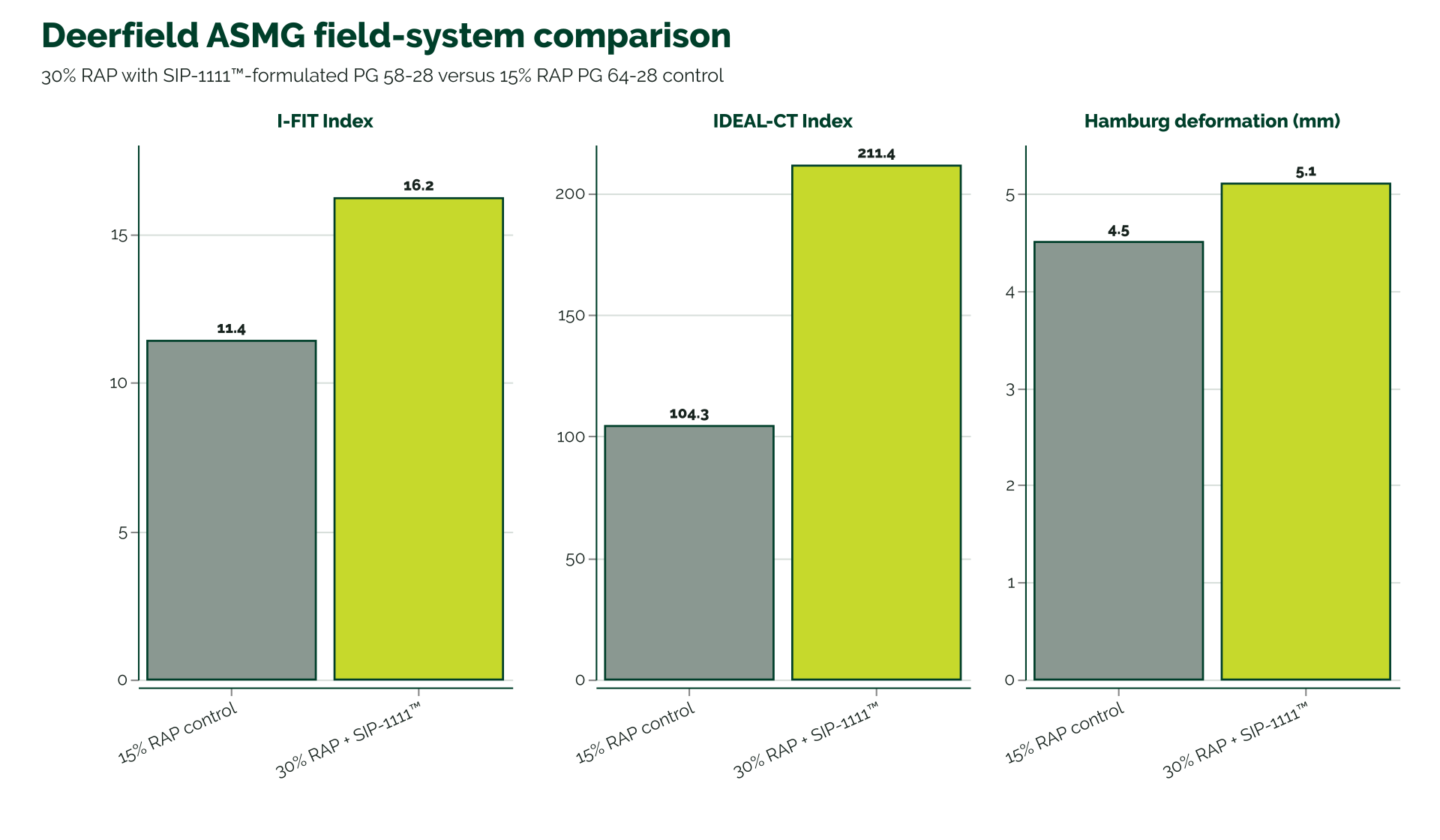
Higher cracking indices and lower Hamburg deformation are favorable; RAP contents and binder grades differ.
| Field system | RAP (%) | Binder | I-FIT | IDEAL-CT | Hamburg deformation (mm) |
|---|---|---|---|---|---|
| Control | 15 | PG 64-28 | 11.4 | 104.3 | 4.5 |
| SIP-1111™ | 30 | PG 58-28 from 30-penetration asphalt | 16.2 | 211.4 | 5.1 |
Source: ASMG Deerfield Field Trial Report. PDF pages 10-12, paired Hamburg reports and cracking-test charts
Review SIP-1111™ · See related demonstration projects · Discuss a high-RAP or hard-blend-stock formulation with SoyLei
Source Documents
- SIP-1111™ Demonstration Paving Results, SoyLei Innovations, 2025