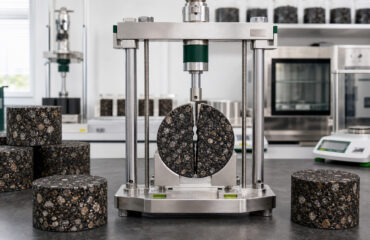

Asphalt Testing Solutions & Engineering, LLC (ATS) evaluated recycling agents, softer binders, and warm-mix additives in a blinded 35% reclaimed asphalt pavement mixture. The February 2021 study approached product selection from the asphalt producer and mix designer’s point of view: compare rutting resistance, cracking response, dosage, and production practicality using a common set of mixture tests.
Two SIP-1111™ treatments appear in the blinded report as Q and R. They produced the two lowest Hamburg deformation values in the study: 1.11 mm for Q and 1.07 mm for R, compared with 1.79 mm for the PG 67-22 control. ATS ranked R first and Q second for Hamburg performance across the blinded treatment set.
A contractor-centered 35% RAP comparison
ATS used locally available Northeast Florida materials in a 12.5 mm Superpave mixture. The design contained 35% RAP and used a PG 67-22 control binder with a continuous grade of 68.5-26.4°C. The RAP binder had a continuous grade of 91.0-14.0°C, and the recycled binder ratio was 0.38.
| Design property | ATS value |
|---|---|
| Nominal maximum aggregate size | 12.5 mm |
| RAP content | 35% |
| Control binder | PG 67-22 |
| Control binder continuous grade | 68.5-26.4°C |
| RAP binder continuous grade | 91.0-14.0°C |
| Recycled binder ratio | 0.38 |
| Design asphalt content | 5.1% |
The laboratory-fabricated, laboratory-compacted mixtures were tested with Hamburg Wheel Tracking under AASHTO T 324, I-FIT under AASHTO TP 124, and IDEAL-CT under ASTM D8225. Supplier dosage recommendations were converted to a common percent-by-weight-of-virgin-binder basis for comparison.
Q and R set the Hamburg pace
Relative to the control, Hamburg deformation was approximately 38% lower for Q and 40% lower for R. The next-lowest blinded treatment measured 1.12 mm, followed by 1.17 mm. Both SIP-1111™ treatments therefore remained at the front of a tightly grouped rutting-resistance tier.
| Blinded treatment | Normalized dosage | Hamburg deformation | I-FIT | CT Index |
|---|---|---|---|---|
| PG 67-22 control | Not applicable | 1.79 mm | 0.38 | 11 |
| SIP-1111™ (Q) | 2.8% | 1.11 mm | 0.31 | 13 |
| SIP-1111™ (R) | 4.5% | 1.07 mm | Not reported | 10 |
| G, leading combined rank | 3.4% | 1.57 mm | 0.79 | 33 |
The cracking results separated the two SIP-1111™ treatments. Q raised CT Index from 11 to 13, while R measured 10. Product G led the report’s combined Hamburg and CT Index ranking with a CT Index of 33 and Hamburg deformation of 1.57 mm. ATS excluded I-FIT from its combined ranking because the report identified inconsistency in those results; R also had no reported I-FIT value.
Performance per unit of dosage
ATS went beyond raw test rank by calculating cracking improvement per millimeter of Hamburg deformation and then dividing that result by normalized dosage. Q recorded a cracking-improvement-to-Hamburg value of 2 and a rounded dosage-efficiency value of 1. R recorded -1 and -0.2, respectively. Products G and L formed the report’s leading dosage-efficiency tier.
These results show why recycling-agent selection belongs inside a balanced mixture-design process. The two SIP-1111™ treatments led Hamburg resistance in this mixture, while their cracking and dosage-efficiency results responded differently. Dosage, binder content, aggregate structure, recycled-binder condition, and the contractor’s performance targets all shape the final design.
What asphalt producers can carry forward
- Normalize dosage before comparing products. ATS received recommendations expressed against RAP, recycled binder, total binder, and total mix. Converting them to one basis made a practical comparison possible.
- Read rutting and cracking together. Q combined the study’s second-lowest Hamburg deformation with a two-point CT Index increase over the control. R delivered the lowest Hamburg deformation and a one-point lower CT Index.
- Design around the project mixture. ATS used one Northeast Florida aggregate structure, one RAP stockpile, and one base binder. The report’s performance-curve method provides a path for selecting binder content around production and performance requirements.
Review SIP-1111™ · Discuss a high-RAP mixture with SoyLei
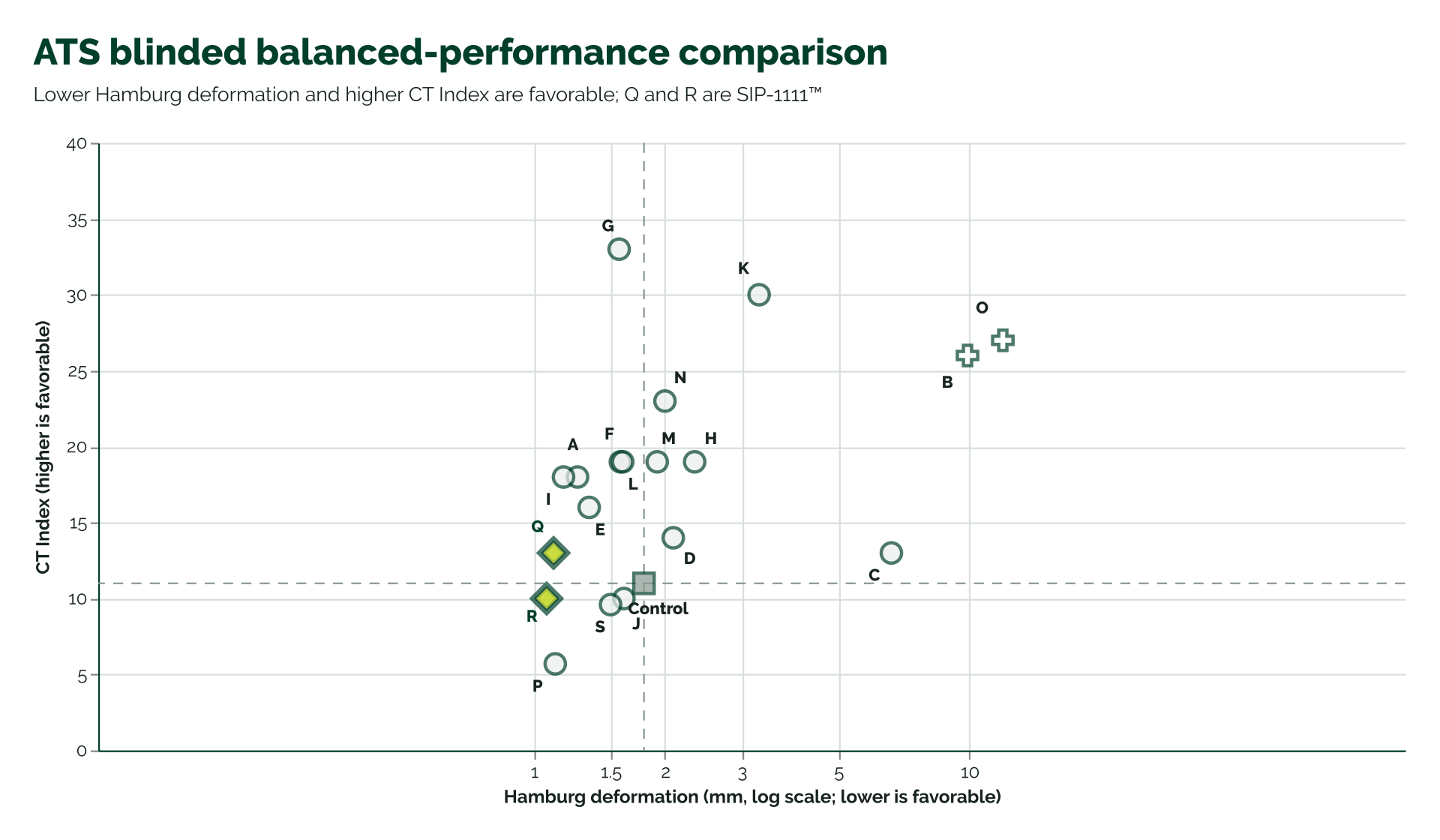
Lower Hamburg deformation and higher CT Index are favorable. B and O were reported with stripping.
| Treatment | Dosage (% virgin binder) | Hamburg deformation (mm) | I-FIT | CT Index | Public classification |
|---|---|---|---|---|---|
| Control | Not reported | 1.79 | 0.38 | 11 | Control |
| A | 4.4 | 1.26 | 0.17 | 18 | Blinded |
| B | 6.3 | 9.9 | 3.21 | 26 | Blinded; stripping observed |
| C | 2 | 6.62 | 1.95 | 13 | Blinded |
| D | 5.6 | 2.09 | 2.53 | 14 | Blinded |
| E | 2.8 | 1.34 | 0.68 | 16 | Blinded |
| F | 3.4 | 1.58 | 0.56 | 19 | Blinded |
| G | 3.4 | 1.57 | 0.79 | 33 | Blinded |
| H | 6.2 | 2.34 | 0.69 | 19 | Blinded |
| I | 2.4 | 1.17 | 0.87 | 18 | Blinded |
| J | 2.5 | 1.61 | 0.55 | 10 | Blinded |
| K | 3.1 | 3.29 | 5.04 | 30 | PG 52-28 |
| L | 0.4 | 1.6 | Not reported | 19 | Blinded warm-mix additive |
| M | 0.5 | 1.92 | 0.51 | 19 | Blinded warm-mix additive |
| N | 0.5 | 2 | 1.65 | 23 | Blinded warm-mix additive |
| O | 3.1 | 11.93 | 6.93 | 27 | PG 52-34; stripping observed |
| P | 0.5 | 1.12 | 0.15 | 5.7 | Blinded |
| Q | 2.8 | 1.11 | 0.31 | 13 | SIP-1111™ |
| R | 4.5 | 1.07 | Not reported | 10 | SIP-1111™ |
| S | 0.5 | 1.5 | Not reported | 9.6 | Blinded |
Source: Evaluation of Recycling Agents – A Contractors Point of View. Asphalt Testing Solutions & Engineering, February 5, 2021, Table 4, PDF page 3
Source Documents
- Evaluation of Recycling Agents – A Contractors Point of View, Asphalt Testing Solutions & Engineering, LLC, 2021-02-05 Blinded report reviewed by SoyLei; public download withheld pending publication permission.
- Chemically mediated asphalt rejuvenation via epoxidized vegetable oil derivatives for sustainable pavements, Fuel, 2023
- Asphalt compositions including epoxidized renewable oils and methods of making and using the same, United States Patent and Trademark Office, 2023-10-03