On October 23, 2018, BioMAG™ entered full-scale accelerated pavement testing on Section W10 at the National Center for Asphalt Technology Test Track in Alabama. The 12.5-mm surface mixture contained 20% reclaimed asphalt pavement and a soybean-based biopolymer-modified binder.
BioMAG™ combines 50% SIP-1111™ rejuvenator with 50% biopolymer. W10 put that dual-function formulation into an instrumented track section exposed to accelerated heavy-truck traffic, creating a direct field record of cracking, rutting, texture, and long-term pavement condition.
Field performance at 5 million ESALs
At 5 million equivalent single axle loads, the W10 section recorded no cracking, 2.5 mm of rutting, and 0.8 mm mean texture depth. The two 20% RAP control sections also recorded no cracking, with approximately 0.2 mm and 0.5 mm of rutting and mean texture depths of 0.6 mm and 0.7 mm.
A 20-million-ESAL pavement record
NCAT continued trafficking W10 after the first-year evaluation. A later NCAT field paper describes the seven-year-old section as having accumulated approximately 20 million ESALs with minimal surface distress before a separate spray-on pavement-preservation study began in 2024.
That pre-treatment condition extends the original construction story from an early demonstration to a long-running accelerated pavement section. The 2024 surface treatments created a new research phase; the approximately 20-million-ESAL condition documents W10 before those treatments were applied.
What W10 demonstrates for asphalt teams
W10 connects three priorities in one field section: recycled asphalt use, polymer-modified binder performance, and long-duration trafficking. BioMAG™ brought SIP-1111™ rejuvenation chemistry and soybean-based polymer into the same formulation, while NCAT measured pavement response over millions of heavy-truck load repetitions.
For producers and agencies evaluating recycled-content or polymer-modified mixtures, W10 provides a full-scale reference point: 20% RAP, no cracking at 5 million ESALs, and minimal surface distress after approximately 20 million ESALs.
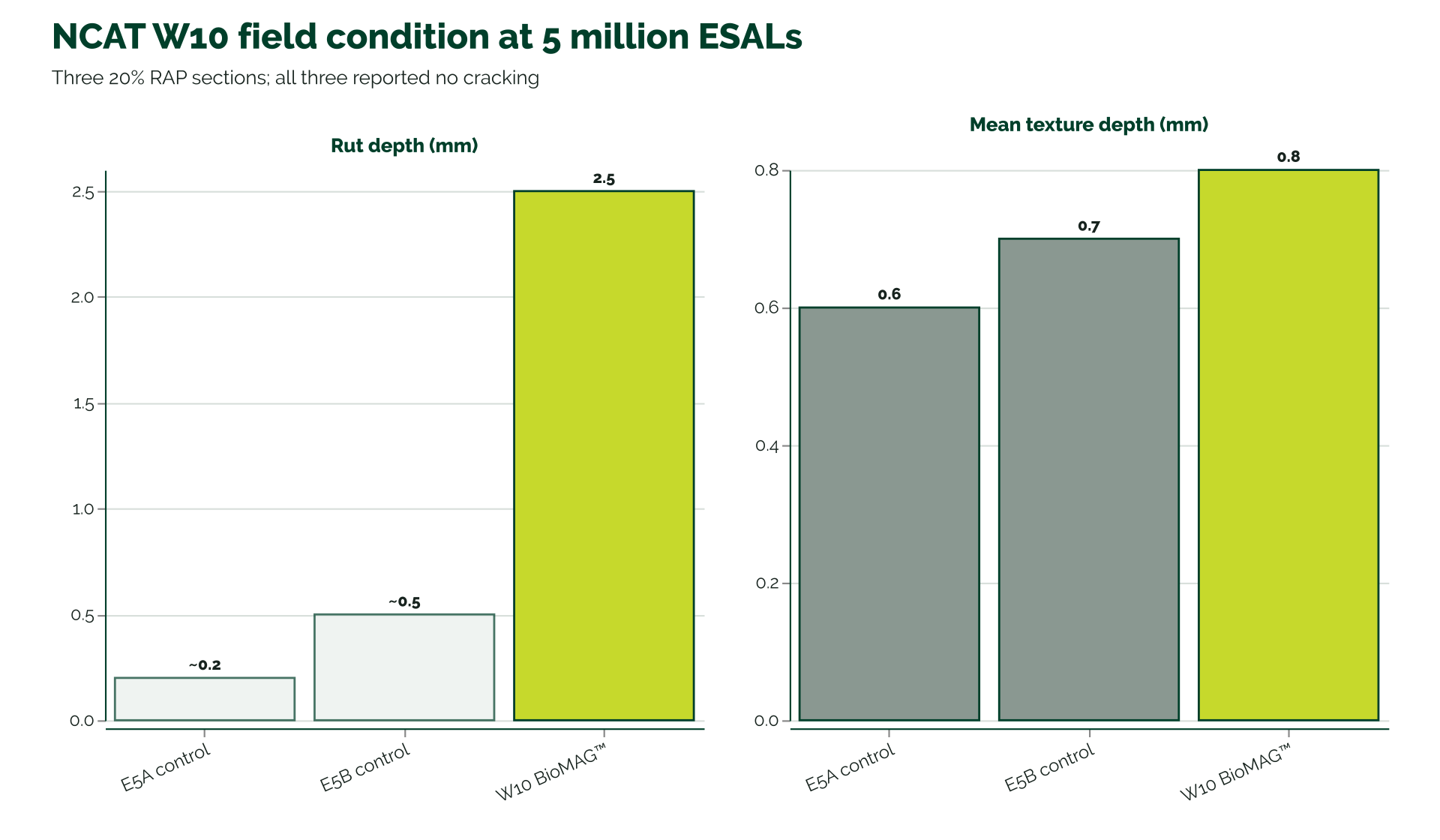
Lower rut depth is favorable; texture depth is descriptive. Control values are approximate as reported.
| Section | RAP (%) | Cracking | Rut depth (mm) | Rut value status | Mean texture depth (mm) |
|---|---|---|---|---|---|
| E5A control | 20 | None | 0.2 | Approximate | 0.6 |
| E5B control | 20 | None | 0.5 | Approximate | 0.7 |
| W10 BioMAG™ | 20 | None | 2.5 | Reported | 0.8 |
Source: Thermoplastic Elastomers Derived From Vegetable Oils. NCAT Test Track BioMAG section, Table 2, PDF pages 4-5
Review SIP-1111™ · See related demonstration projects · Discuss a recycled asphalt or polymer-modified binder program with SoyLei
Source Documents
- BioMAG Soybean-Derived Polymer Proves Its Worth at NCAT, AsphaltPro, 2021
- Development of Bio-Based Polymers for Use in Asphalt, Phase II, Iowa State University Institute for Transportation, 2020